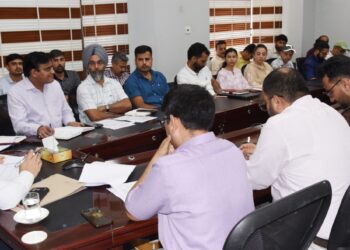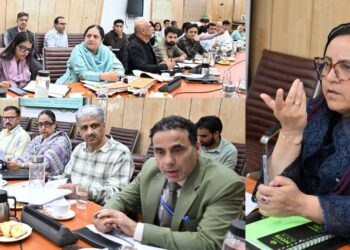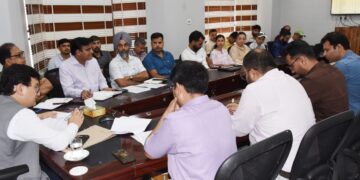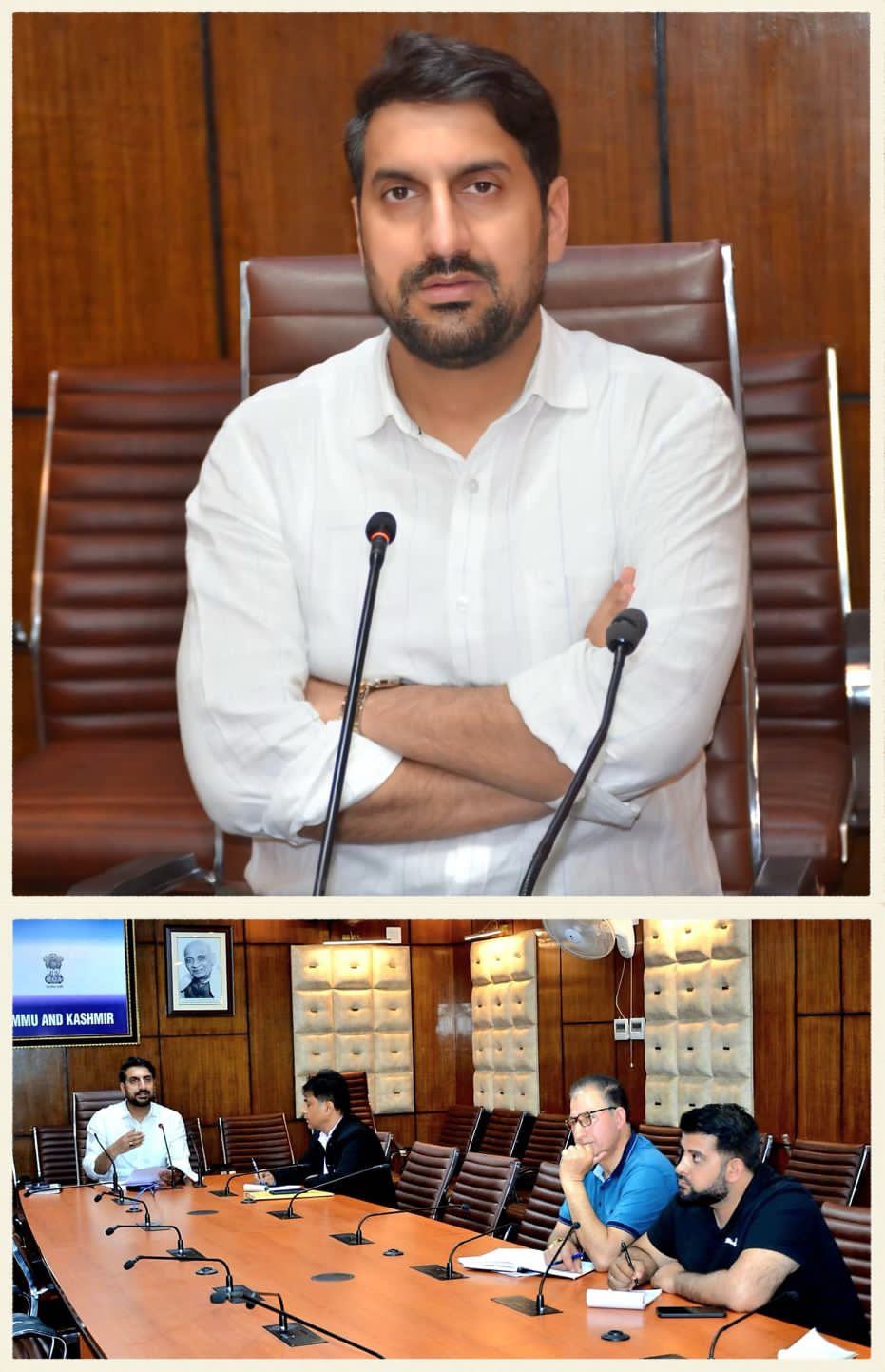
SRINAGAR, APRIL 23: Secretary, Rural Development Department (RDD) and Panchayati Raj, Mohammad Aijaz Asad, today chaired a meeting to review the draft Operations and Maintenance (O&M) and Faecal Sludge and Septage Management (FSSM) policies, which are in the final stages prior to notification, under the Swachh Bharat Mission–Grameen (SBM-G).
The meeting was attended by Director General Rural Sanitation Anoo Malhotra, Director Finance Umar Khan, Superintending Engineers REW (Jammu/Kashmir), Deputy Directors Rural Sanitation and other senior officers.
The Secretary directed that key features be refined and aligned before notification, particularly with regard to enforcement provisions and a clear appellate mechanism. He emphasized that the Assistant Commissioner Panchayat (ACP) should act as the appellate authority, with oversight at the Directorate level.
Reviewing alignment with the Solid Waste Management Rules, he reiterated that Panchayats will be empowered to levy user charges and impose penalties for non-compliance, especially for failure to ensure source segregation.
“Source segregation is the cornerstone of effective waste management and must be strictly enforced,” he said, stressing segregation into dry, wet, sanitary and special waste streams.
The Secretary underscored the role of Deputy Commissioners, as heads of District Sanitation Committees, in strengthening the monitoring frameworks, particularly for door-to-door collection systems and ensuring elimination of visible litter. He also called for preparation of district-specific waste management plans, detailing logistics such as vehicle deployment, manpower, collection frequency and ward-wise schedules.
On financial sustainability, he stressed the rationalisation and enforceability of user charges, noting limited willingness to pay in rural areas.
The meeting also discussed provisions related to the Bulk Waste Generators (BWGs), including incorporation of Extended BWG Responsibility in the policy framework.
Highlighting the need to sustain SBM-G gains, the Secretary called for a robust, community-driven O&M framework to maintain sanitation assets, particularly in over 5,900 ODF Plus villages across the UT.
The officials informed that 10 percent of PRI Capex allocation has been earmarked for O&M of sanitation and SLWM assets.
Regarding FSSM, he emphasized the importance of a structured system for safe collection, transportation, treatment and disposal of faecal sludge, noting that nearly 60 percent of rural households rely on on-site sanitation systems.