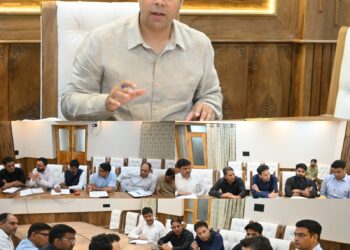
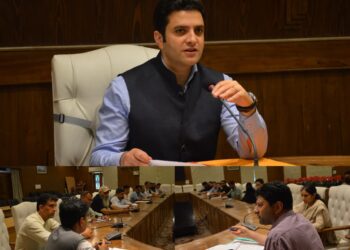
UDHAMPUR, APRIL 23: Secretary Labour and Employment, Kumar Rajeev Ranjan, who is designated as District Mentor for Udhampur, chaired a meeting today to review the implementation of the Nasha Mukt J&K Abhiyan in the district.
The meeting was attended by Deputy Commissioner Minga Sherpa; Additional District Development Commissioner Jugal Kishore; Additional Deputy Commissioner Prem Singh, General Manager DIC; Chief Planning Officer; Assistant Commissioner Revenue Assistant Commissioner Development, Assistant Commissioner Panchayat and other district and sectoral officers, including representatives from the Police Department.
At the outset, the Additional Deputy Commissioner delivered a detailed PowerPoint presentation outlining the proposed District Action Plan for the 100-day Nasha Mukt Abhiyan. The Deputy Commissioner also provided key inputs and suggestions to strengthen the strategy.
While reviewing the action plan, the District Mentor emphasized the need to devise a Standard Operating Procedure (SOP) for systematic follow-ups. He directed for appointing nodal officers at Panchayat, village and ward levels to ensure continuous monitoring and accountability.
Ranjan stressed the importance of focusing on quantifiable outcomes and called for the activation of youth clubs to function as grassroots-level support systems. These clubs, he noted, should act as “eyes and ears” of the administration by providing feedback and identifying individuals vulnerable to drug abuse.
He further highlighted the need for convergence between the Youth Engagement and Empowerment Plan and the Nasha Mukt Abhiyan to ensure a coordinated and impactful approach.
Emphasizing capacity building, the Mentor directed all departments to achieve saturation in online awareness and training programs, supplemented by regular follow-ups. He also underscored the importance of developing preventive IEC (Information, Education and Communication) material, including “Do’s and Don’ts” related to drug use and motivational content targeting youth.
District Mentor called for the involvement of religious leaders and successful entrepreneurs as ambassadors for youth clubs and also suggested the constitution of Mahila Nigrani Samitis to strengthen community-level vigilance.
Additionally, he proposed the development of a dedicated mobile application to provide easy access to IEC materials, helpline numbers and information on the nearest medical facilities. He also emphasized wide publicity of toll-free helpline numbers at district, block and Panchayat levels.
Special focus was laid on targeting the 14–18 age group, identified as the most vulnerable segment. The Mentor further recommended the development of psychometric tools to identify at-risk individuals and the creation of a Google-based feedback mechanism for public participation.
The meeting concluded with a commitment from all stakeholders to work in a coordinated and mission-driven manner to achieve the objectives of a drug-free Udhampur.