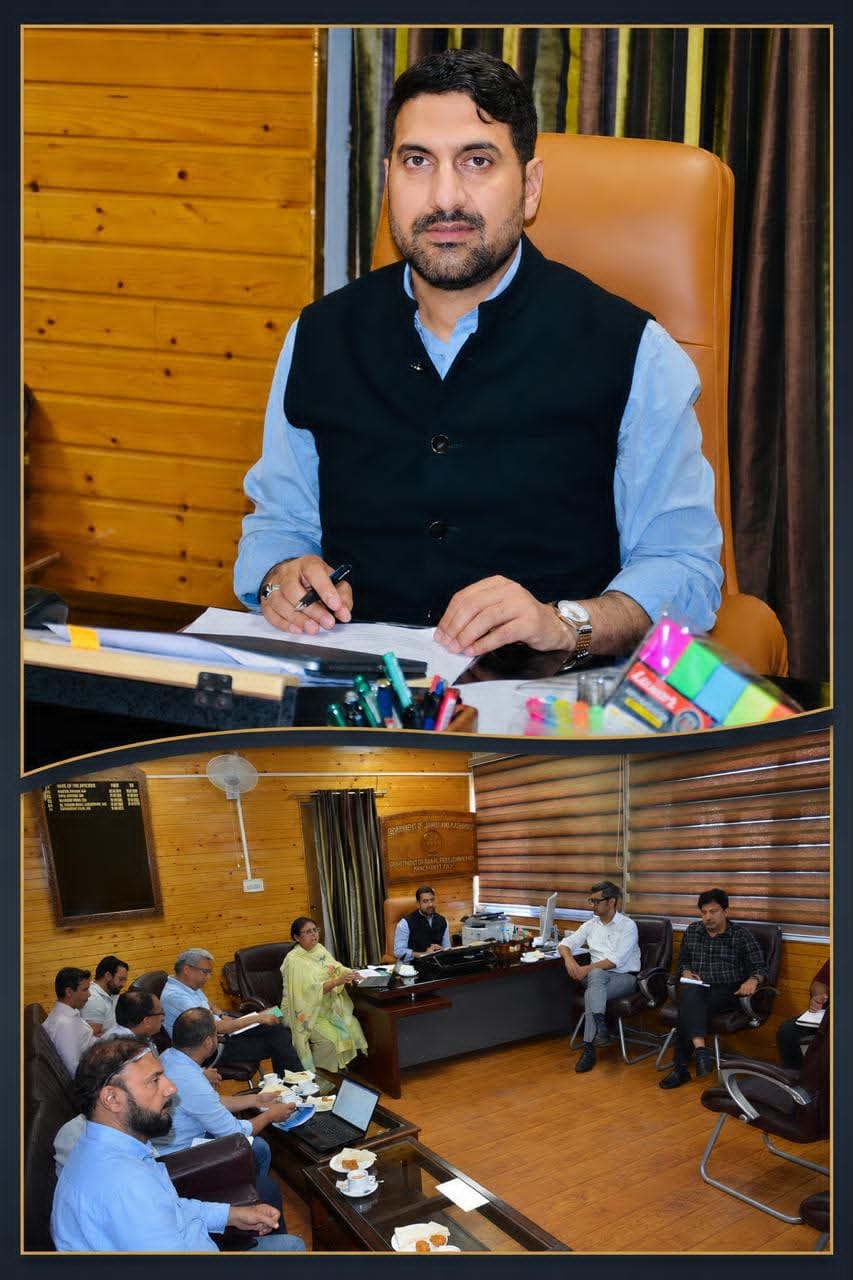
SRINAGAR, JULY 15: Secretary, Rural Development Department (RDD) and Panchayati Raj, Mohammad Aijaz Asad, today chaired the meeting of the Union Territory Level Steering Committee on the Lakhpati Didi Initiative under the Jammu & Kashmir Rural Livelihoods Mission (JKRLM-UMEED), directing all stakeholder departments to adopt a mission-mode approach for transforming women Self-Help Group (SHG) members into sustainable entrepreneurs through effective convergence, skill development and financial inclusion.
The meeting was attended by Mission Director, JKRLM, Dr. Shubhra Sharma; Director, Agriculture & Farmers Welfare, J&K; Directors, Animal Husbandry, Jammu and Kashmir; Directors, Social Welfare, Jammu and Kashmir; Chief Operating Officer, Himayat (DDU-GKY), J&K; Additional Secretary RDD, Waseem Raja, Deputy Director, Fisheries, Kashmir; and other senior officers.
Addressing the meeting, the Secretary said the Government is accelerating implementation of its flagship Lakhpati Didi Initiative with a renewed focus on enabling rural women to establish sustainable micro-enterprises and achieve annual household incomes exceeding ₹1 lakh.
Aijaz Asad informed that 2.40 lakh women in Jammu & Kashmir have already attained Lakhpati Didi status, while the overall target for the Union Territory has been fixed at 3.64 lakh women by 2029, requiring focused efforts to cover an additional 1.24 lakh beneficiaries through convergence, enterprise development, access to credit and skill enhancement.
Emphasising convergence as the cornerstone of the initiative, Secretary directed all stakeholder departments to integrate their flagship schemes with JKRLM and prioritise eligible SHG households under their respective programmes.
He stressed the need for preparing household-level enterprise plans, ensuring timely institutional credit, providing continuous handholding support, and facilitating market linkages for women entrepreneurs. He called upon every department to identify convergence opportunities under its schemes and communicate clear beneficiary targets and implementation strategies.
The Secretary instructed all line departments to prepare a comprehensive convergence blueprint indicating the number of beneficiaries they can support in sectors such as agriculture, horticulture, livestock, dairy, poultry, fisheries and other allied activities, ensuring coordinated implementation down to the village level.
Highlighting the importance of quality skill development, he directed the Mission to strengthen partnerships with reputed national institutions and specialised training organisations while studying and adopting best practices from leading States. He also advised organising exposure visits for officials and stakeholders to replicate successful livelihood models in Jammu & Kashmir.
Aijaz Asad further directed the Mission to engage with leading private apparel brands and manufacturers to explore outsourcing opportunities for women-led enterprises, observing that such partnerships could create sustainable employment and significantly enhance household incomes. He emphasised the need to upgrade the existing skill ecosystem to meet industry standards and improve market competitiveness.
He stressed that capacity building should go beyond classroom-based training and focus on practical, market-oriented skills that enable women to establish viable enterprises. Departments including Agriculture and Horticulture were directed to provide hands-on technical training in scientific farming, apple cultivation, vegetable cultivation, protected cultivation and other high-value agricultural activities capable of generating sustainable incomes.
The Secretary also called for expanding convergence beyond traditional sectors by involving institutions working in digital services, handicrafts, handloom, apparel manufacturing, food processing and other emerging livelihood sectors, observing that a diversified livelihood portfolio would create greater economic resilience for rural women.
The meeting was informed that the Digital Aajeevika Register (DAR) is being utilised for household identification, beneficiary tracking and progress monitoring, while the Enterprise Planning Digital Tool (EPDT) is facilitating preparation of customised enterprise plans, investment assessment and income forecasting for individual households, thereby strengthening evidence-based planning and monitoring.
Reviewing financial inclusion measures, the Secretary was informed that under the SHG Bank Linkage Programme, institutional credit worth ₹1,200 crore is targeted for potential Lakhpati Didis. Additionally, 4,200 women will be supported during the current financial year under the Lal Ded Stree Shakti Scheme, implemented in collaboration with J&K Bank, through individual micro-loans amounting to ₹42 crore.
The meeting further reviewed banking outreach initiatives under which 372 Bank Mitras and 710 Banking Correspondents are providing doorstep banking services across rural areas. Financial literacy camps and enrolment drives under various social security schemes are also being organised across all blocks to strengthen the financial security and resilience of SHG members.
Concluding the meeting, Aijaz Asad reiterated that the Lakhpati Didi Initiative is not merely an income enhancement programme but a transformative movement aimed at empowering rural women through entrepreneurship, financial independence and sustainable livelihoods.
He directed all stakeholder departments to work in close coordination with JKRLM, adopt a results-oriented approach, and ensure timely achievement of the Union Territory’s targets through measurable outcomes, strong institutional convergence and sustained field-level support.