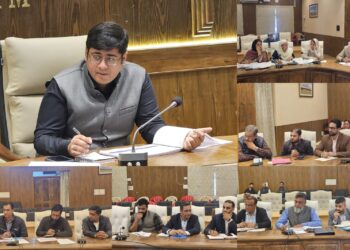
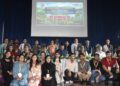
JAMMU, OCTOBER 22: The Departments of Botany and Zoology, School of Sciences, Cluster University of Jammu (CUJ), under the aegis of IQAC on Thursday inaugurated a two-day International conference on “Viksit Bharat 2047: Biodiversity Conservation for Sustainable Future” here at PSPS Government College for Women Gandhi Nagar.
The inaugural ceremony was graced by Member of Parliament, Rajya Sabha Gulam Ali Khatana as the chief guest and Prof. A. Ravinder Nath, Vice-Chancellor, Central University of Kashmir, as the guest of honour and keynote speaker.
The programme commenced with the reception of dignitaries and ceremonial lamp lighting.
Prof. Sugandha Mahajan, Organising Secretary of the conference and Head, Department of Botany, Cluster University of Jammu, conducted the proceedings of the inaugural ceremony, guiding the programme through its key segments and ensuring the smooth progression of the formal proceedings.
Dr. Chander Shekhar, Dean, School of Sciences, delivered the welcome address, emphasizing the importance of interdisciplinary research, environmental awareness and community participation in biodiversity conservation.
Dr. Meenakshi Bandral, Director, IQAC and Convenor of the conference, presented an overview of the conference, outlining its theme, aims, goals and expected outcomes. She also briefed the gathering on registration and the conference’s key thematic areas, noting that more than 200 participants had registered from reputed institutions across India.
In his presidential address, Sr. Prof. K. S. Chandrasekar, Vice-Chancellor, Cluster University of Jammu highlighted the role of higher education and scientific research in advancing the vision of Viksit Bharat @2047.
Gulam Ali Khatana motivated researchers and students to develop practical conservation solutions, emphasizing local community participation, traditional ecological knowledge and collective responsibility for protecting forests, rivers, wetlands and wildlife.
Delivering the keynote address, Prof. A. Ravinder Nath highlighted habitat restoration, climate-resilient conservation and the integration of scientific research with traditional knowledge. He encouraged students and young researchers to contribute through biodiversity documentation, citizen-science initiatives and technology-driven environmental monitoring.
The technical sessions featured two international speakers. Dr. Amit Kumar, Nanjing University of Information Science and Technology, China, delivered a lecture entitled “Forest Soil Nutrient Stocks Along Altitudinal Range of Himalayas,” highlighting the importance of altitudinal variation in forest soil nutrients and ecosystem functioning.
Dr. Pushpinder Singh Jamwal, University of Molise, Italy, Species Co-Coordinator, IUCN SSC Otter Specialist Group, and Deputy Coordinator, Himalayan Otter Network, presented “From Habitat Suitability to Connected Rivers: Species Distribution and Connectivity Modelling for Otter Conservation in a Viksit Bharat 2047.” His presentation highlighted the application of species distribution and connectivity modelling to otter conservation, emphasizing the protection of river corridors and freshwater ecosystems.
The lectures were followed by interactive discussions among speakers, delegates, faculty members and research scholars, encouraging scientific exchange and future research collaboration. The sessions were chaired by Prof. Kuldeep Krishan Sharma, Former Vice-Chancellor, Himalayan University, Itanagar, and Asutosh Mookerjee Fellow, Indian Science Congress Association (ISCA), and co-chaired by Dr. Harish Chander Dutt, Senior Assistant Professor, Department of Botany, University of Jammu.
A poster presentation competition attracted more than 50 participants from reputed institutions across India, showcasing research and innovative ideas in biodiversity conservation and environmental sustainability. The evaluation committee will announce the results during the valedictory session.
The inaugural day concluded with a vote of thanks presented by Dr. Kuldeep Raina, who expressed gratitude to the dignitaries, speakers, participants, university administration, faculty members, students and organising team for their valuable contributions and support. He acknowledged the collective efforts that helped ensure the successful commencement of the conference.
The two-day international conference will continue on October 23, 2026, with further scientific deliberations and academic interactions aimed at advancing biodiversity conservation and sustainable development in alignment with the vision of Viksit Bharat @2047.