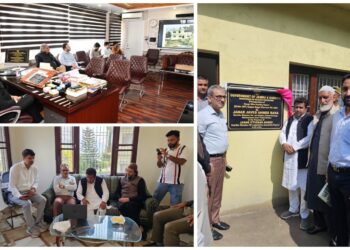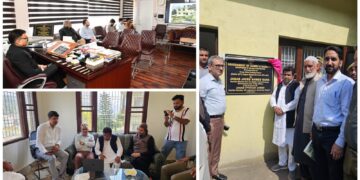
JAMMU, SEPTEMBER 8: To mark the International Day of Clean Air for Blue Skies, the Department of Ecology, Environment & Remote Sensing (DEERS) – EIACP Hub, J&K, in collaboration with the Directorate of Industries & Commerce, Jammu organized a One-Day Capacity Building Workshop here at Bari Brahmana Industries Association (BBIA), SIDCO Industrial Complex.
The programme began with a plantation drive led by dignitaries of the event. The programme was attended by ESC Jammu/Coordinator EIACP Programme of MoEF&CC Dr. Rajan Singh; President BBIA Lalit Mahajan; Vice President Ajay and General Secretary Viraj, Functional Manager Bharat Bhushan; Functional Manager Pankaj Singh Jasrotia; Functional Manager Amit Kumar Digra; Industrial Promotion Officer Rajeshwar Singh; Range Officer DEERS Anil Sharma; Programme Officer EIACP Dr. Kirti and owners of Industrial Units.
The Coordinator Dr Rajan Singh delivered the welcome address and explained about the air quality which is closely linked to the earth’s climate and ecosystems globally and importance of the day.
The workshop commenced with an enlightening lecture by Divisional Nodal Officer, NPCCHH DHS Jammu Dr. Rashmi Sharma, highlighting the serious health implications of air pollution, including respiratory disorders, cardiovascular diseases and increased vulnerability to climate related illnesses.
Associate Professor, Central University of Jammu Dr. Ankit Tandon spoke on “Targeting Clean Air for Blue Skies: Role of Industries in Mitigating Aerosol Pollution”, stressing that aerosols were one of the main causal agents of air pollution. He emphasized that construction, vehicular, biomass burning etc. emissions contribute significantly to air pollution and climate change, leading to rising temperatures, extreme weather events and ecosystem degradation.
The Speakers further highlighted that Air pollution is contamination of the both indoor and outdoor environment and it can be due to any chemical, physical or biological agent that modifies the natural characteristics of the atmosphere. Household combustion devices, motor vehicles, industrial facilities and forest fires are common sources of air pollution. Pollutants of major public health concern include particulate matter, carbon monoxide, ozone, nitrogen dioxide and sulfur dioxide. Outdoor and indoor air pollution cause respiratory and other diseases and are important sources of morbidity and mortality. The event concluded with a vote of thanks by Dr Kirti PO underlined the need for collaborative efforts to reduce air pollution, build climate resilience and ensure sustainable development.