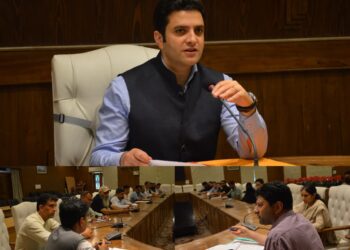
SRINAGAR, JULY 9: Commissioner Secretary, Department of Public Grievances, Saurabh Bhagat today chaired a review meeting to assess the functioning and performance of J&K SAMADHAN, the Union Territory’s flagship grievance redressal and monitoring platform.
During the meeting, a comprehensive review of J&K SAMADHAN was undertaken covering grievance registration, disposal trends, departmental performance, citizen feedback mechanisms and overall system functionality.
Commissioner Secretary emphasized the importance of strengthening the grievance redressal ecosystem to ensure timely, transparent and effective resolution of public grievances and to further enhance citizen satisfaction.
The meeting was informed that J&K SAMADHAN is proposed to be migrated to the MeghRaj Government Cloud infrastructure. The migration is expected to provide a secure, scalable and reliable hosting environment, improve system availability, strengthen disaster recovery capabilities and align the platform with the Government of India’s cloud adoption framework. Shri Saurabh Bhagat directed the concerned officers to take necessary steps for migration of the platform to MeghRaj Cloud in a time-bound manner to ensure enhanced performance, security and operational efficiency.
Commissioner Secretary also directed the concerned officers to initiate the development of J&K SAMADHAN 3.0, envisaged as a next-generation citizen engagement and governance platform for the Union Territory. He emphasized that the proposed platform should build upon the strengths of the existing J&K SAMADHAN system while incorporating advanced technologies and best practices from successful citizen governance platforms implemented across the country.
Saurabh Bhagat observed that J&K SAMADHAN 3.0 should evolve beyond a conventional grievance redressal platform and serve as a comprehensive citizen-government interaction ecosystem. The proposed platform shall integrate citizen engagement, grievance redressal, service delivery monitoring, governance analytics, Artificial Intelligence, GIS-enabled monitoring and decision support systems into a unified digital framework.
Commissioner Secretary further directed that the proposed platform should leverage emerging technologies such as Artificial Intelligence (AI), Machine Learning (ML), AI-powered Voicebots and Chatbots, multilingual citizen interfaces, predictive analytics, governance dashboards and intelligent decision-support tools. The platform shall provide seamless access to citizens through multiple channels including web portals, mobile applications, toll-free helplines, WhatsApp, SMS, email and other digital interfaces to ensure inclusive and accessible governance across Jammu & Kashmir.
During the meeting, Saurabh Bhagat emphasized the need to replicate successful grievance redressal models adopted by other States within the JK Samadhan framework. In this regard, it was directed that the feasibility of adopting and suitably customizing proven best practices from other States be examined for implementation in the Union Territory of Jammu & Kashmir, with a view to expediting the development of a modern, efficient, and citizen-centric governance ecosystem.
Commissioner Secretary further directed that Bhaskaracharya National Institute for Space Applications and Geo-informatics (BISAG-N) may be considered as the Technology Partner for J&K SAMADHAN 3.0 for providing technical expertise in platform integration, customization, localization, GIS integration, dashboard development, interoperability with departmental systems and implementation support. The proposed collaboration is expected to facilitate adoption of a proven governance framework while reducing development timelines, implementation risks and overall project costs.
Saurabh Bhagat directed the Department of Public Grievances, State e-Mission Team (SeMT) Department of Information Technology to work in close coordination for preparation of a detailed roadmap, technical architecture and implementation strategy for the development and rollout of J&K SAMADHAN 3.0.
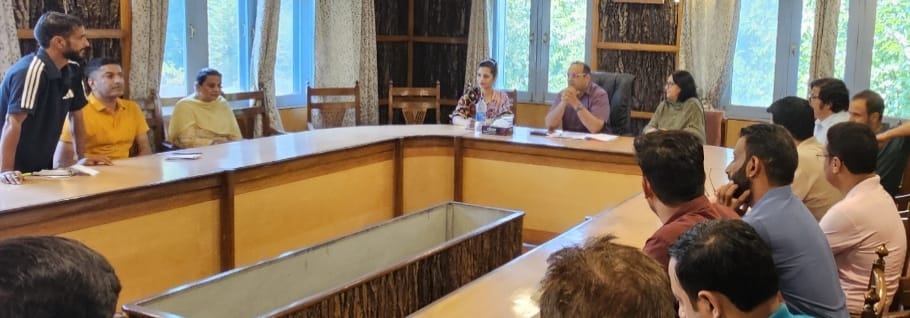
The meeting was attended by officers of the Department of Public Grievances, Department of Information Technology, State e-Mission Team (SeMT) and other concerned stakeholders.