SRINAGAR, AUGUST 01: In a major step towards integrating clean energy with agriculture, Sher-e-Kashmir University of Agricultural Sciences and Technology of Kashmir (SKUAST-K) has announced the establishment of a 50-kW agrivoltaics (AgriPV) research pilot at its Shalimar Campus in collaboration with the Centre for Study of Science, Technology and Policy (CSTEP).
The project aims to evaluate crop performance, energy efficiency, economic viability and farmer adoption of agrivoltaics under Kashmir’s unique agro-climatic conditions.
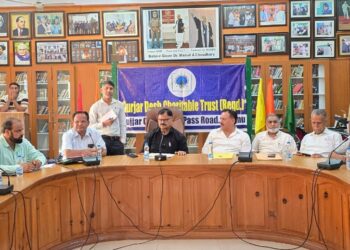
The announcement was made by Vice Chancellor, Prof. Nazir Ahmad Ganai during the workshop “Building the Agrivoltaics Ecosystem in Jammu and Kashmir”, jointly organised by CSTEP and SKUAST-K. The workshop, aligned with the upcoming PM-KUSUM 2.0 scheme, brought together policymakers, scientists, industry representatives, financial institutions and farmers to explore pathways for scaling agrivoltaics across the Union Territory.
“This workshop is only the beginning of a long-term collaborative journey towards a resilient, climate-smart and energy-secure future for our farming communities,” Prof. Ganai said.
The proposed research facility will serve as a demonstration and innovation platform to generate scientific evidence on dual land use, where crops and solar energy are produced simultaneously. Researchers will study suitable cropping systems, energy generation, farm economics and adoption models to support future policy and large-scale deployment in Jammu and Kashmir.
Speaking at the event, Saptak Ghosh, Sector Head, Renewables and Energy Conservation at CSTEP, said Kashmir has remained underserved in agricultural and energy innovation despite being a major contributor of hydropower. He said agrivoltaics provides an opportunity to combine the Valley’s horticultural strengths with renewable energy generation without displacing farmers from their land.
“Unlike conventional solar leasing models, our approach keeps farmers at the centre by enabling electricity generation alongside near-farm value creation. Through our pilot with SKUAST-K and the National Institute of Solar Energy (NISE), we hope to demonstrate this model directly to farmers and local communities,” he said.
Highlighting policy challenges, Junaid Akhtar, Assistant Engineer (Solar), Kashmir Power Distribution Corporation Limited (KPDCL), said that while distribution companies generally procure solar power at competitive tariffs, the additional agricultural and rural development benefits of agrivoltaics should be recognised through viability gap funding to improve financial viability. Earlier, Prof. Javeed Ahmad Mugloo, Head, Krishi Vigyan Kendra Pulwama, SKUAST-K, emphasised that integrating agrivoltaics with high-value crops and livestock rearing could strengthen market linkages and encourage value-added products, creating new rural enterprises across the Valley.
The partnership forms part of CSTEP’s work under the India Agrivoltaics Alliance (IAA), a multi-stakeholder platform promoting agrivoltaics in India. Under the collaboration, CSTEP has been developing region-specific agrivoltaics models tailored to Jammu and Kashmir’s agro-climatic conditions, including high-density apple orchards.
The workshop witnessed participation from experts representing the National Institute of Solar Energy (NISE), The Energy and Resources Institute (TERI), CSIR-NIIST, the National Solar Energy Federation of India (NSEFI), government departments, financial institutions, industry stakeholders and the farming community.
The initiative reflects University’s continued commitment to climate-smart agriculture, renewable energy research and farmer-centric innovation aimed at strengthening both food and energy security in Jammu and Kashmir.