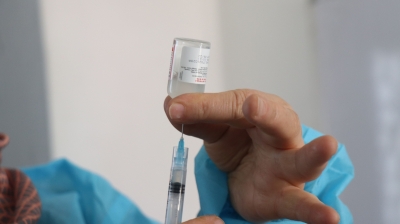
Srinagar: With winter approaching, experts have advised people to get flu vaccine shots to prevent soaring viral infection in Kashmir.
Flu shots are vaccine doses that help prevent people from catching influenza like H1N1. Getting annual flu shots is considered to be the best bet of defense against catching the infection especially during winters in Kashmir. Kashmir being a cold region is prone to H1N1 outbreak.
Dr Manzoor Khan, a physician, said the ideal time for the flu vaccine is October. “It takes 2-3 weeks to develop antibodies. It’s recommended that we take an annual shot of flu vaccine these days. We get most cases like H1N1 in winters and springs,” he told news agency Kashmir Indepth News Service (KINS).
He said that cold, body aches, fever, headaches, muscle aches, are the symptoms of H1N1. “It is not necessary; a person suffering from these diseases is having H1N1. Even mild cold or fever could also be symptoms of the influenza,” he said.
He said that people should maintain hygiene to prevent the virus. “It may not be fatal for healthy people. Those suffering from respiratory problems or asthma, elderly people, shall take proper medication and influenza to prevent H1N1,” he added.
Another physician Dr Adil Ahmad said flu shots are important to prevent influenza and its associated morbidity and mortality.
“Flu shots as such will not prevent from Covid but it is very imperative to control the frequency of influenza cases by vaccinating all people in general and vulnerable in particular,” he said.
He said the illness caused by Covid-19 and influenza has almost similar clinical presentation.
“Since the virus keeps on mutating every year, people are asked to get flu shots every year. H1N1 virus emerges during winters. Cold weather is aggravating the problem,” he added.
The H1N1 influenza was detected for the first time in Kashmir in 2010, claiming two lives. In 2013, 76 cases were detected and two died of H1N1 influenza. During 2017, 23 people died from the virus in the Valley. Before that 21 people died in 2015. Atleast 250 H1N1 patients have been reported in 2018. Since then cases are reported every year and claiming many lives.
“Those who lost their lives over the years were infected with H1N1 but they were also suffering from leukemia, malignancies, sepsis acute respiratory syndrome, Chronic Obstructive Pulmonary Disease (COPD) which led to the weakness in their immune system,” an official at SKIMS Soura, said. (KINS)