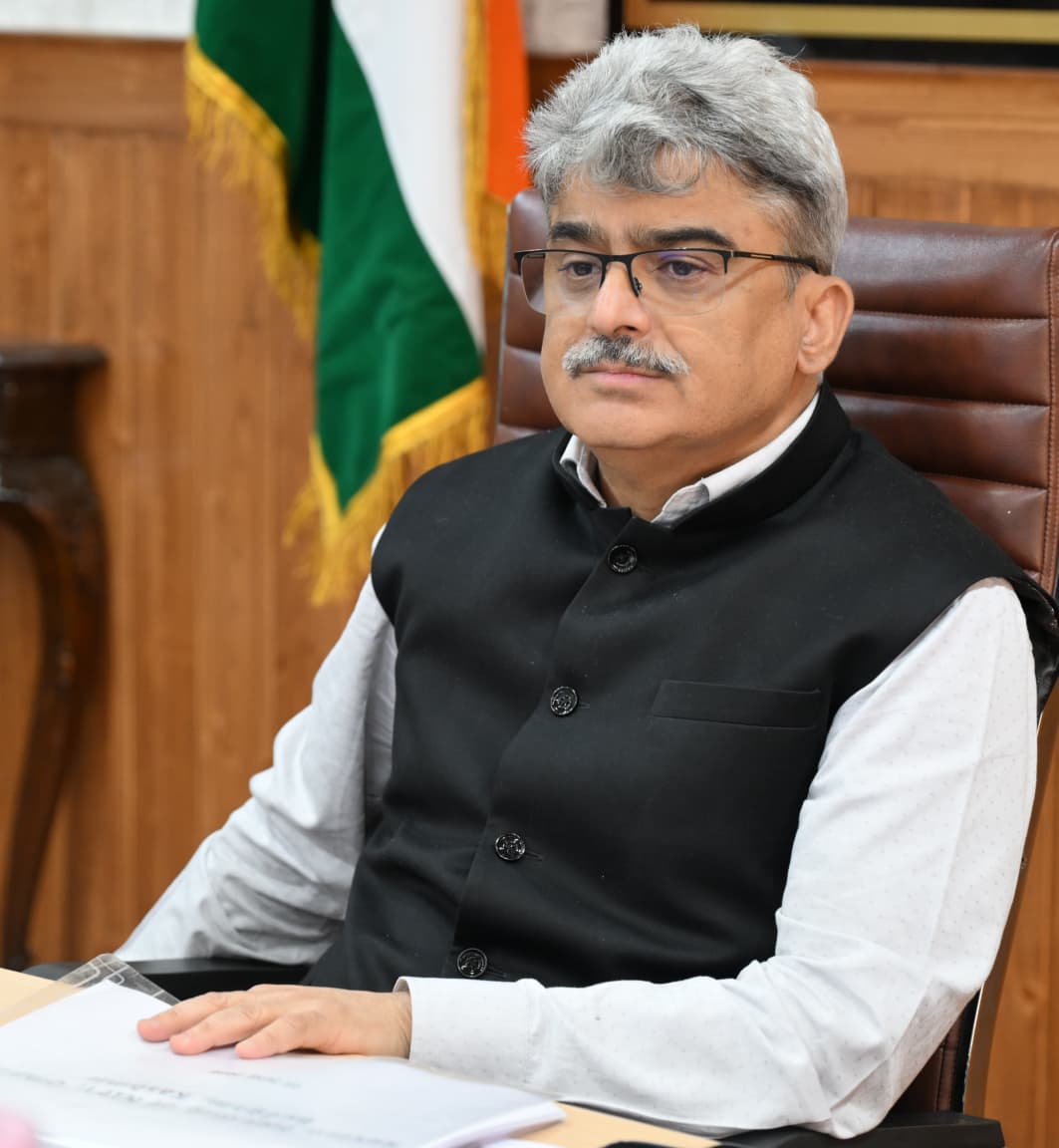
SRINAGAR, JUNE 18: Chief Secretary, Atal Dulloo, today reviewed the proposed Circular Economy framework for J&K put forth by the Housing & Urban Development Department (H&UDD), aimed at establishing a resource-efficient, low-waste and environmentally sustainable development model across the Union Territory.
The meeting besides Commissioner Secretary, H&UDD was attended by Commissioner, JMC; CiTaG Professionals and other concerned officers.
The proposed policy envisions transforming Jammu & Kashmir into a regenerative Himalayan economy where waste materials are going to be converted into productive resource flows safeguarding the region’s ecological integrity, enhancing urban governance and generating sustainable livelihoods.
During the presentation, the Chief Secretary was informed that the policy has been conceived in response to emerging regulatory requirements under the Solid Waste Management Rules, 2026, judicial directives concerning waste management and environmental protection, increasing waste generation linked to tourism and pilgrimage activities, and the need to protect the UT’s ecologically sensitive lakes, wetlands, forests and mountain landscapes.
The framework recognizes unique circular economy opportunities of J&K owing to the large tourism footfall, extensive pilgrimage circuits, a well established horticulture economy worth nearly ₹12,000 Cr and the geographical realities of mountainous terrain. Accordingly, the policy proposes an implementation architecture tailored specifically to the capacities and circumstances of different urban local bodies and regions.
A key feature of the policy, as highlighted by the Commissioner Secretary, Mandeep Kaur is the adoption of a ‘Differentiated Circularity Framework’, under which urban local bodies will be assigned implementation responsibilities according to their operational capacity, waste generation levels and infrastructure readiness.
Under the proposed framework, she made out that the smaller and remote urban local bodies will adopt a Basic Circular Model centred on waste reduction, reuse and aggregation. These local bodies will establish ward-level Reduce-Reuse-Recycle (RRR) centres, encourage household composting, create collection systems for recyclables and rely upon cluster-level processing facilities rather than investing in expensive standalone infrastructure. The model seeks to minimise transportation costs while ensuring effective waste recovery in geographically challenging regions.
The roadmap also envisages medium-sized urban local bodies implementing the Circular+ Model, which introduces decentralised composting systems, mini material recovery facilities, small-scale biogas plants, repair-and-reuse initiatives and strengthened compliance mechanisms for bulk waste generators. The model focuses on local processing of wet waste while building stronger recycling and recovery systems.
For Jammu and Srinagar cities, the Commissioner JMC, Devansh Yadav elucidated that the policy proposes an advanced Circular++ Model, positioning both cities as regional circular economy anchors.
He revealed that the model envisages integrated resource recovery systems comprising city-wide segregation, bio methanation and compressed biogas facilities, construction and demolition waste processing plants, bulk waste generator compliance mechanisms, wastewater reuse through sewage treatment plants, digital traceability systems and regional support functions for surrounding urban centres. The two capital cities are expected to serve as processing and market hubs for higher-order circular economy activities.
The presentation further highlighted the adoption of a Cluster-Based Circular Economy Model following a hub-and-spoke architecture wherein advanced processing infrastructure is concentrated at strategic hubs while smaller urban centres function as collection and aggregation nodes.
Seven priority circular economy clusters have been proposed, namely the Jammu Metropolitan Urban Materials and Construction & Demolition Cluster; Srinagar Valley Organics and Lake-Sensitive Circularity Cluster; Apple and Horticulture Biomass Cluster; Pilgrimage and Tourism Circular Services Cluster; Artisan, Silk and Upcycling Cluster; Mountain Decentralised Circular Livelihoods Cluster; and Urban Water Reuse and Sludge Recovery Cluster.
The framework also identifies nine priority value chains for intervention including municipal dry waste recovery, organic waste and bio-inputs, plastic and packaging recovery, horticulture biomass, tourism and pilgrimage waste management, construction and demolition waste recycling, wastewater reuse, repair and refurbishment systems, and artisan-based circular production networks.
To ensure effective implementation, the policy proposes a six-pillar architecture comprising regulatory reforms, financial mechanisms, institutional arrangements, market development systems, digital governance tools and livelihood-generation initiatives.
The implementation roadmap has been structured into four phases. The first phase will focus on institutional activation, baseline assessments, tiering of urban local bodies and infrastructure preparation for the smooth and flawless implementation of the framework.
The second phase will concentrate on pilot clusters, compliance systems and market activation. The third phase envisages scaling-up and replication across the Union Territory, while the final phase focuseson mature circular systems, cost recovery and long-term sustainability.
The Chief Secretary stressed the importance of developing a practical, technology-driven and financially sustainable framework capable of delivering measurable environmental, economic and social outcomes. He emphasised the need for strong inter-departmental coordination, effective convergence of existing schemes and robust digital monitoring systems to ensure successful implementation of the policy.
He maintained that once implemented, the framework is expected to significantly improve waste recovery rates, reduce landfill dependence, strengthen ecological protection, generate green livelihoods, promote circular enterprises and enhance overall urban governance across Jammu & Kashmir.