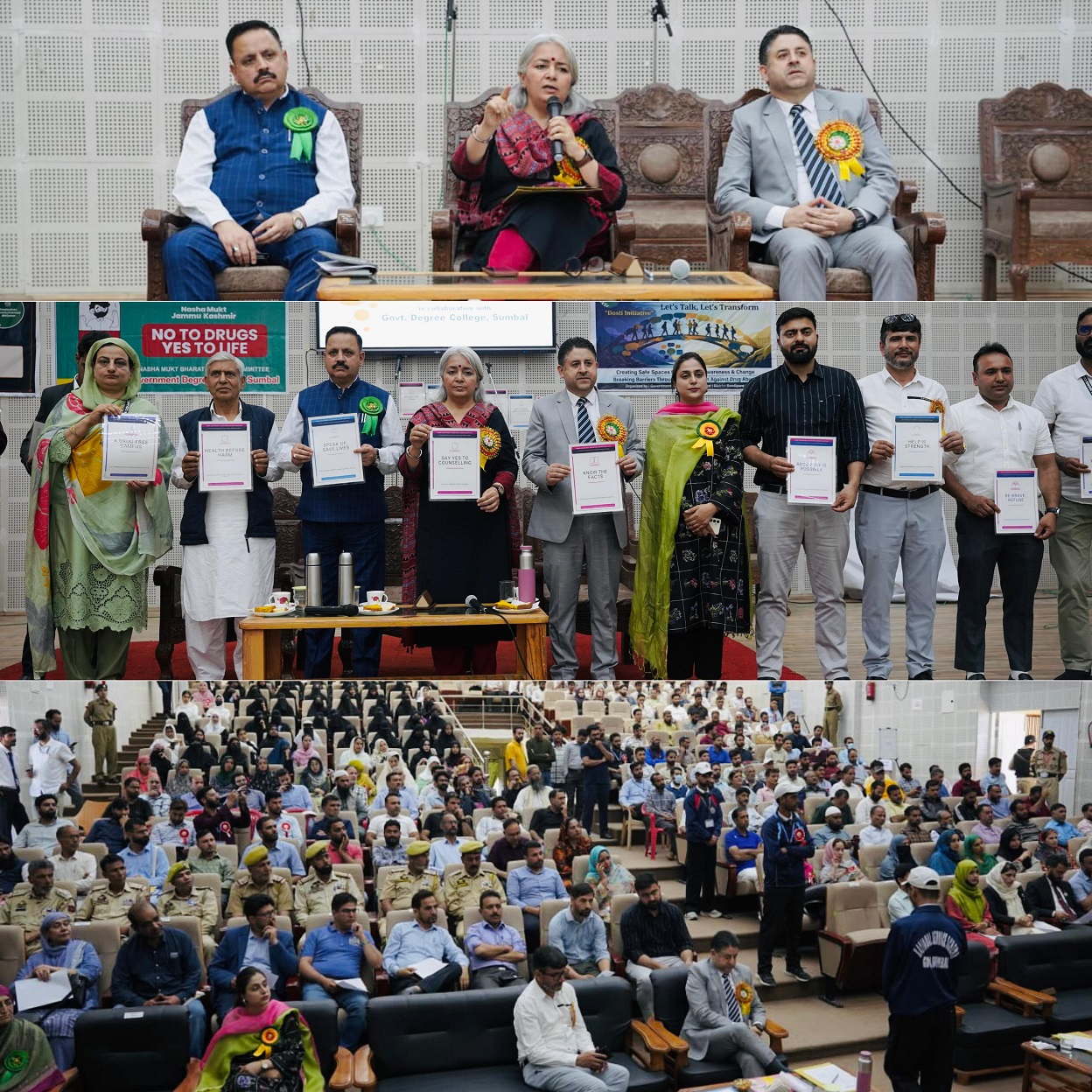
BANDIPORA, MAY 18: District Administration Bandipora, in collaboration with Government Degree College (GDC) Sumbal, today organised a Psychiatry Convention on De-addiction under the ongoing 100-Day Nasha Mukt Jammu and Kashmir Abhiyan, placing the scientific, psychological, and social dimensions of addiction at the centre of the district’s anti-drug drive.
The convention was led by Member of Legislative Assembly (MLA), Bandipora, Nizamuddin Bhat, and Deputy Commissioner Bandipora, Indu Kanwal Chib, with Head of Department of Psychiatry, SKIMS Medical College Srinagar, Dr Abdul Majid, and Registrar, University of Kashmir, Dr Naseer Iqbal, serving as the principal resource voices of the day.
Among those present on the occasion were Principal GDC Sumbal, Prof. Shabeena Iqbal Shawl; Sub-Divisional Magistrate Sumbal; Assistant Commissioner Development Bandipora; Assistant Commissioner Panchayat Bandipora; Deputy District Education Officer; District Information Officer; Drug Control Officer; faculty members of GDC Sumbal; officers from various line departments; educators; and a large gathering of students.
MLA Bandipora, in his address, stressed parental responsibility, the institutional role of schools, and the centrality of compassion in addressing addiction. Invoking the concept of collective consciousness, he observed that both positive and negative influences shape individual mindsets and remarked that “a good word is better than silence.” The MLA had earlier administered the Nasha Mukt Jammu and Kashmir Abhiyan pledge to the participants.
Addressing the gathering, Deputy Commissioner Bandipora, clarified that the convention was not a routine awareness event but a dedicated scientific session focused on the psychological dimensions of addiction. She announced that the District Administration would review on-ground progress after one month and urged the youth to remain focused, hopeful, and actively engaged in building a drug-free Bandipora. She added that voices from within the community carry a weight that no policy document or awareness pamphlet can match.
Delivering the keynote address, Dr Abdul Majid, described the 100-Day Nasha Mukt J&K Abhiyan as a much-needed initiative launched under the guidance of the Lieutenant Governor. He underlined that drug abuse erodes education, family structures, social fabric, and financial stability, and stressed the importance of healthy companionship, open parent-child communication, and early screening.
Clarifying a widespread misconception, he stated that drug abuse is neither hereditary nor inborn, and urged affected individuals to seek help without hesitation or stigma. He outlined a six-point framework for a healthy lifestyle: adequate sleep, balanced diet, connecting physically with people, devoting oneself to social causes, extra-curricular engagement, and turning challenges into opportunities.
The Registrar, University of Kashmir in his address, dwelt at length on the shared responsibility of society and the academic community in confronting the menace of drug abuse. He underlined the pivotal role of teachers as moral anchors and early identifiers, observing that the bond between a teacher and a student often becomes the first line of defence against destructive influences. Most importantly, he emphasised that cultivating mental strength, resilience, and a sense of purpose is the surest internal safeguard against addiction, and called upon students to invest as much in their psychological well-being as in their academic pursuits.
Assistant Professor, Department of Psychiatry, SKIMS, Dr Syed Mehvish, delivered a clinical presentation on the causes, consequences, and prevention of substance abuse. She identified peer pressure, stress, curiosity, personal setbacks, parental influence, and adverse life events as primary risk factors, and elaborated on the physical, psychological, familial, and social damage caused by addiction. She emphasised the need for healthy peer relationships, mental resilience, and timely access to mental health support.
In a particularly moving moment during the proceedings, a recovered drug user came forward to share his personal journey of addiction and recovery before the gathering. His testimony drew warm applause from the audience and was acknowledged by the experts on the dais as a powerful real-world reinforcement of the day’s clinical message.
During an interactive session, students raised pointed concerns about substance abuse. Responding, the Deputy Commissioner urged the youth not to be lured by negative influences, while Dr Abdul Majid advised students to engage with the real world rather than virtual relationships, and to learn the discipline of saying “No” to harmful choices.
The convention concluded with a signature campaign and a renewed commitment from all stakeholders to intensify the fight against drug abuse in district Bandipora.