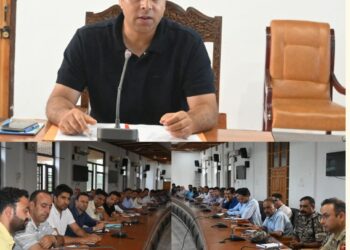
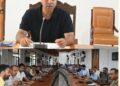
BUDGAM, APRIL 04: Deputy Commissioner (DC) Budgam, Athar Aamir Khan, today chaired a detailed review meeting to assess sector-wise issues, concerns, and welfare measures pertaining to persons with special abilities, with special focus on specially-abled children across the district.
A comprehensive memorandum outlining department-wise demands and challenges was presented during the meeting, highlighting gaps in implementation, accessibility constraints, and the need for strengthened institutional support.
Taking note of the issues raised, the DC issued detailed, time-bound directions to all concerned departments for prompt redressal and effective implementation on the ground.
It was informed that persons with special abilities are facing difficulties in accessing benefits under existing schemes. Stakeholders demanded immediate implementation of the Rights of Persons with Disabilities Act, 2016, provision of assistive devices including wheelchairs, tricycles/scooties, hearing aids, elbow sticks, laptops, and distribution of essential items to needy beneficiaries.
The DC directed the Social Welfare Department to ensure saturation of all eligible beneficiaries, streamline distribution of assistive devices, enhance financial assistance, and facilitate livelihood opportunities through vendor carts, prefabricated stalls, and designated vending spaces at key public locations.
Issues related to certification, lack of proper verification, and non-availability of specialists were highlighted. Concerns were also raised regarding rejection of railway concession forms due to improper stamping.
The DC directed the Chief Medical Officer to standardize certification strictly through specialists, ensure proper stamping with name, registration number, and place of posting, conduct medical boards at accessible locations (preferably ground floor), and strengthen monitoring mechanisms to prevent misuse. He further instructed to explore provision of special health insurance, free diagnostics, and availability of specialized medical professionals.
Demand for development of dedicated sports infrastructure, including indoor and mini stadiums, along with provision of sports kits and exposure opportunities was also raised.
The DC directed the Sports Department to promote sports activities among persons with special abilities, organize regular tournaments, and prepare a phased plan for creation of inclusive sports infrastructure.
Concerns regarding lack of accessibility in schools, absence of special educators, and limited educational support were highlighted. Stakeholders demanded free admission, scholarships, Braille books, sign language interpreters, vocational training, and home-based education.
The DC directed the Chief Education Officer to ensure barrier-free access in all schools, appointment of special educators, and provision of scholarships, study material, and exam concessions. He also stressed capacity building of teachers in special education.
The memorandum highlighted inadequate inclusion of persons with special abilities under MGNREGA and other schemes.
The DC directed the Rural Development Department to ensure their inclusion with due reservation, provide housing support, and facilitate sustainable livelihood opportunities.
It was demanded that all eligible persons with special abilities from economically weaker sections be covered under AAY ration cards.
The DC directed the concerned department to ensure identification and coverage of all such beneficiaries under NFSA provisions without delay.
Issues regarding implementation of fare concessions and facilitation in issuance of driving licenses were also raised.
The DC directed the RTO to ensure strict implementation of concessional provisions and conduct special drives for issuance of driving licenses to eligible applicants.
Concerns regarding lack of lifts, ramps, and accessible infrastructure in government buildings and public spaces were also highlighted.
The DC directed the Public Works Department to make all public infrastructure barrier-free and ensure incorporation of accessibility features in all ongoing and future projects. He further directed that no new project should be approved without adherence to accessibility norms and inclusive design standards.
The DC also directed the Revenue Department to simplify procedures, ensure time-bound issuance of certificates, and make offices accessible, preferably at the ground floor.
Stakeholders demanded improved accessibility in banks, priority services, and provision of soft loans to artisans with special abilities.
The DC directed banking institutions to ensure barrier-free access, extend priority services, and facilitate financial inclusion through easy credit and support for participation in exhibitions and livelihood activities.
The DC emphasized close inter-departmental coordination to ensure effective implementation and directed that no eligible beneficiary should be left out.
He reiterated that ensuring dignity, accessibility, and equal opportunities for persons with special abilities remains a top priority of the district administration and called for a mission-mode approach for holistic inclusion.
Among others, the meeting was attended by Programme Officer ICDS, General Manager DIC, Additional Commissioner Revenue, Chief Medical Officer, Chief Education Officer, Chief Agriculture Officer, District Development Employment Officer, District Social Welfare Officer, Assistant Director FCS&CA, other concerned officers and delegation of specially abled persons of the district.