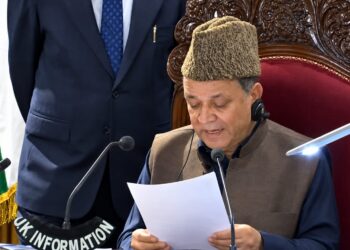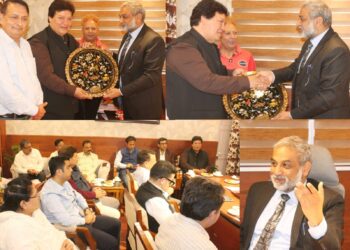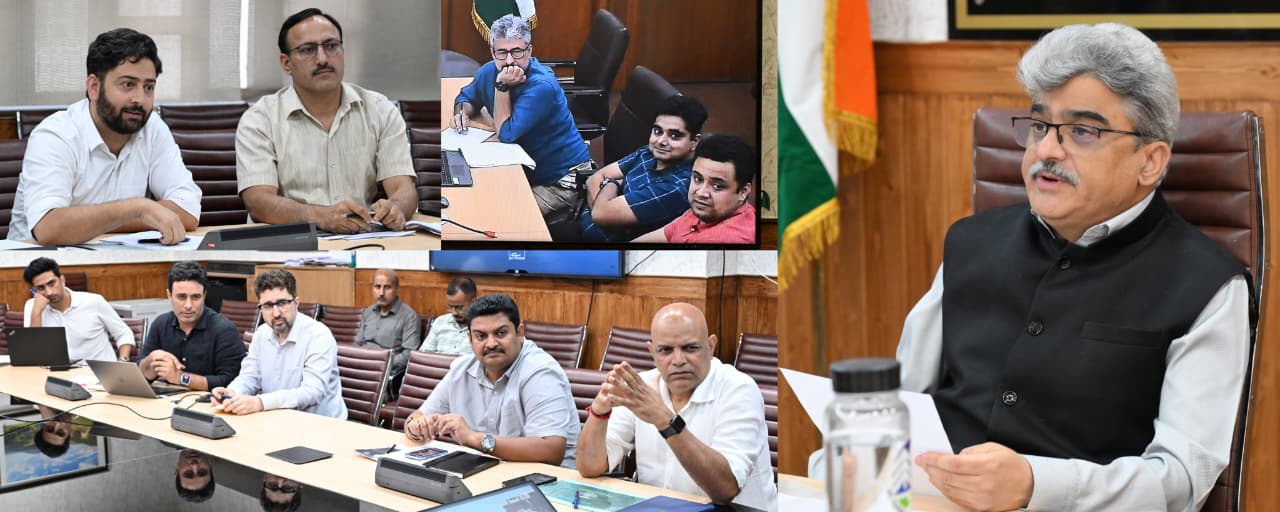
SRINAGAR, AUGUST 14: Chief Secretary, Atal Dulloo, chaired a meeting of the Tourism Department to review the renewed Homestay Policy aimed at expanding homestay infrastructure across Jammu & Kashmir, promoting tourism in unexplored destinations and creating sustainable livelihood opportunities for local communities.
The meeting was attended by Additional Chief Secretary, Tourism; Commissioner Secretary, GAD; Director, I&C, Jammu; Director, Tourism, Kashmir/Jammu; representatives of J&K Bank and other concerned officers.
Describing homestays as the bedrock of tourism in unexplored destinations, the Chief Secretary observed that these offer an environmentally sustainable model particularly suited to an ecologically fragile region like J&K.
He emphasised that promotion of homestays would not only expand tourism beyond established destinations but also make local residents active stakeholders in tourism development, generating employment and income opportunities across different strata of society and contributing to an overall improvement in their standard of living.
The Chief Secretary directed the Tourism Department to undertake greater handholding and intensive capacity-building initiatives for prospective and existing homestay owners so that local communities are adequately equipped to provide quality services to visitors.
He further called upon financial institutions to extend necessary financial support for augmentation, renovation and improvement of homestay facilities under the renewed policy framework, observing that easier access to finance would encourage more households to participate in the initiative.
During the meeting, the Tourism Department gave a detailed presentation on the existing homestay ecosystem and the provisions incorporated under the renewed policy.
The ACS, Tourism, Dr Ashish Chandra Verma divulged that a homestay, under the policy framework, refers to a residential property where the owner/promoter and family reside on the premises, with a provision for a minimum of one and maximum of six guest rooms, subject to prescribed standards relating to safety, hygiene, water supply and electricity. Adding that Jammu & Kashmir presently has a total accommodation capacity of 20,514 beds across 2,802 homestay units.
He also highlighted that the policy provides homestay owners with a range of benefits, besides an additional source of household income. It was given out that the same includes official recognition by the Tourism Department, promotion through J&K Tourism platforms, access to training and capacity-building programmes, facilitation of financial assistance through Government schemes and banking institutions, participation in tourism promotion campaigns and enhanced visibility among domestic and international tourists.
The meeting was also informed about the introduction of the Bed & Breakfast (B&B) model, under which secondary residential properties can now be registered for tourist accommodations too.
Under the model, owners can offer between one and six rooms for accommodation, thereby providing an opportunity to generate income from vacant or underutilised residential properties while simultaneously increasing the availability of tourist accommodation across the UT.
The renewed framework also provides for a simplified online registration process through the J&K Tourism portal. Applicants can upload property details, photographs and requisite documents online, enabling greater visibility among tourists through official digital platforms.
The initiative also envisages easier discovery of registered properties through digital integration and geotagging, besides providing a dedicated platform for promotion of homestays across Jammu & Kashmir.
The meeting further discussed the financial inclusion component of the initiative being facilitated through J&K Bank. Under the financing arrangement, loans for converting a residential house into a homestay can be extended up to ₹5 lakh per room, subject to a maximum of ₹30 lakh per homestay, depending upon the average conversion requirements.
The Department also highlighted the digital integration carried out under Mission YUVA, through which the J&K Government has partnered with OYO for the “Crown of Incredible India” Homestay Initiative.
The initiative seeks to promote village-based entrepreneurship and self-employment opportunities for youth through the establishment and promotion of homestays, thereby creating new avenues for local livelihood generation while taking tourism deeper into rural and lesser-explored areas.
One more feature of this framework incorporates a simplified and time-bound inspection mechanism. An Inspection Committee will assess registered applicants on the basis of a prescribed checklist and assign Silver or Gold category based on compliance with the stipulated standards.
Applicants uploading all requisite documents as per the prescribed checklist will be granted provisional registration under the Silver Category for a period of six months. Further, if verification is not completed within 15 days, the registration shall be deemed to have been automatically approved, thereby reducing procedural delays and providing greater certainty to applicants.
The renewed Homestay Policy is aimed at creating a more inclusive, digitally enabled and financially supported tourism ecosystem, with local households and youth positioned at the centre of tourism-led economic development across Jammu & Kashmir.